 Techlead Consulting
The Scorecard of Reality: how I assess a business when I first come in
Two versions of the same company
Most companies I have been involved with, in permanent or just contract positions, had two versions of themselves. One lives in the board reports, the CRM and the process documents, the other is how work gets done day to day and who really makes the decisions. On my first day nobody can tell me where the two differ which is rarely because anyone is hiding something.
Very often this gap continues to grow if not attended to. A dashboard that was right a while ago keeps being reported long after the process behind it has changed. A workaround that started as a favour between two people becomes the way orders actually get delivered and nobody writes it down. Each of these is small and sensible on its own. Together though, they mean the leadership team is steering by a picture that is partly measured and partly believed, while the board report presents both with the same confidence.
That is the first thing I need to sort out, before I recommend any bigger change. If I start fixing the business as it is reported, I can end up fixing the wrong things very efficiently. So I start by building what I call a Scorecard of Reality which is a short reading of the business where every line says what we believe is true and how sure we are of it.
What goes on the scorecard
The Scorecard is deliberately small. It has four or five lines, each one a statement about how the company is doing as a whole in a fundamental area. For example, a single late delivery (sales or development) never gets a line of its own, however much trouble it caused. It belongs behind a line as one piece of the evidence. That is because I believe that once single events get lines of their own, the scorecard turns into a task list and stops telling the board anything about the shape of the business.
The lines usually fall into five areas, though the wording changes with each company, because a software business and an FMCG distributor for instance lose money in very different places. Behind each line sits a small set of things I check:
- Money: what customers really pay after discounts, where exceptions to the price list have quietly become normal and how much of the revenue comes back every year.
- Sales and customers: which accounts could leave in the next six months and why we win and lose, from what buyers tell me as well as what the sales team recorded.
- Delivery: how long it takes from a signed deal to the customer getting real value and where work breaks when it passes from one team to another (handover issues).
- Decisions and culture: who actually decides, what, how long it takes and which decisions keep getting reopened.
- Technology: whether the systems fit the way the business makes money or whether people have built their own workarounds to them.
Once the work is done, each area comes down to one line that says what we believe and how sure we are of it, using one of the three marks I explain in the next section. Delivery, for example, might read like this:
Delivery: conflicting. We report that customers are up and running on time. The project records show when the work finished but customers describe waiting several more weeks before their teams could use it or that the project doesn't fully respond to their needs.
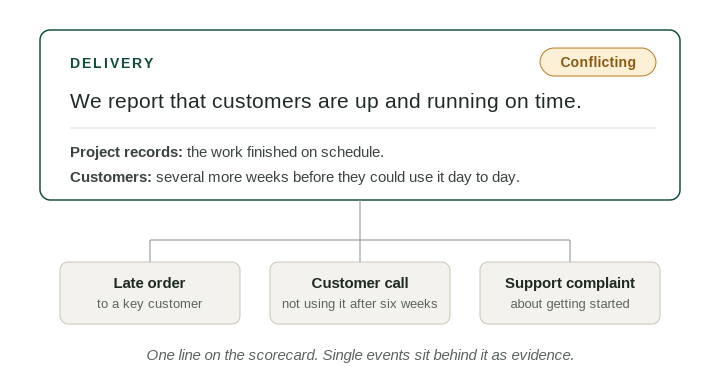
The line names one claim and shows exactly where the doubt sits. A late order, a customer call and a support complaint all sit behind it as evidence.
Culture sits with decisions on purpose. I think it matters as much as anything on the scorecard, but it is hard to read directly and easy to describe in words everyone agrees with. The most honest reading of it I have found is how decisions really get made and whether people speak up when they disagree.
How I build each line
I build every line on the scorecard from two sources. The first is what the records say: the accounts, the CRM, the support tickets and the project plans. The second is what the people closest to the work say, including customers, sometimes investors if needed. I sit in on sales calls, listen to support calls, walk through recent deals that were won or lost and talk to customers who renewed as well as some who did not.
Asking about specific recent cases works much better than asking people how things work in general. Asked in general, most people describe the process as it was designed. Asked about one particular order that went out late, they describe what actually happened, workarounds included.
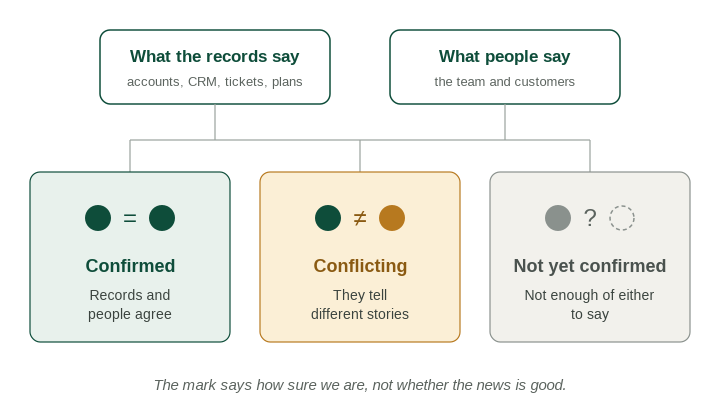
When I put the two together, each line gets one of three marks: confirmed when the records and the people agree, conflicting when they tell different stories and not yet confirmed when I do not have enough of either to say.
Records and people are not always independent of each other, because most records are written by the same people I talk to. The reason a deal was lost, for example, is usually typed into the CRM by the salesperson who ran it, often in a hurry once the deal is closed. If they then tell me we lost on price, the CRM agreeing with them proves very little. It is the same view, written down earlier. So before I mark a line confirmed, I look for something that does not come from that same person. That can be the customer explaining why they chose someone else. It can also be a record the sales team did not write, such as the final quote and the discount on it.
The mark says how sure we are, not whether the news is good or bad. A line can be confirmed and still be bad, such as margins that everyone agrees are leaking through discounts. Not yet confirmed is not a failure either. It tells the board plainly what is still unknown, which is more useful than a confident number that turns out to be wrong later on.
What the conflicts tell you
The conflicting lines are usually the most useful part of the scorecard. A conflict shows where the company works differently from how it is described. It does not yet tell me what the gap costs, but it tells me where to look further.
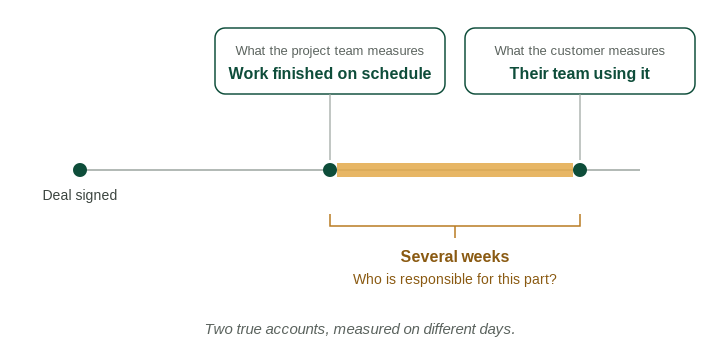
A conflict rarely means someone is wrong or hiding something. More often both sides are telling the truth from where they stand. In the delivery line above, the project team can be right that the work finished on schedule and the customers right that they waited weeks, because they are talking about different dates: the day the work finished and the day the customer's team could actually use it. I look first at what happened between those two dates and whether anyone was responsible for that part of the customer's experience.
Reading the lines together tells you more than reading them one by one. A conflict in delivery can turn out to explain a renewal problem that sales could not account for, though that link has to be checked like any other. The decisions line often connects the others, because the same question keeps coming up: who was supposed to own this? A line that stays not yet confirmed for a long time also needs explaining. The records may be poor, people may use the same word for different things or I may not have heard from enough customers yet. Each of those points to a different fix.
This is why I present conflicts to the board as findings about the business, not about people. Once a leadership team stops arguing about who is right, they can agree on what is true. That is the point where fixing things becomes possible.
From scorecard to action
The scorecard is only useful if it leads to action(s). Boards rarely need another document to read. They need to know what happens next and who is doing it.
So the scorecard and the first fixes run side by side. While I am still building the reading, some problems are too obvious and too costly to wait for, such as a renewal at risk with nobody chasing it or a pricing exception that has become everyone's habit. Those get an owner and a next step straight away. An early fix matters as much for the team as for the numbers, because it shows them the work leads somewhere.
The rest comes out of the scorecard itself. Some findings are clear enough to act on. Others need more conversation or a closer look at the records before I would recommend a change. I bring the board a small number of priorities to agree, each with an owner and a way to judge progress. I would rather see three changes finished than ten started. When I join a company as a fractional COO, the same scorecard then becomes the baseline I report against every month.
When the same problem has survived several attempts to fix it, I run the Performance X-Ray together with an experienced executive coach. The Scorecard of Reality is my part of the work. I might find that a decision which belongs to a team leader keeps going back to the CEO. My colleague might ask what happened the last time that team leader made the call and it went badly. We bring the two accounts together because the answer changes what we recommend. At the end the board gets our findings and a plan for the few changes we think matter most.
When the mark changes
The scorecard is not a one off. I keep updating it and a useful moment is when a line changes its mark. A month later I come back to the delivery line. This time the project team and the customers agree on how long it takes to get up and running. The question I ask the board is whether we have shortened the wait or whether, for the first time, we can see how long it is. If it is the latter, the scorecard has done its job, even though the customer is still waiting.
There is a third possibility which is harder to spot. Everyone may simply have got used to the wait. Customers stop complaining about things they have been forced to accept as normal, so the records and the conversations start to agree without anything having changed. Their silence does not mean they are satisfied because in reality the wait keeps wearing down their patience and trust which can show up months later as churn. That is why a line that suddenly looks settled gets the same questions from me as one that is still in doubt.